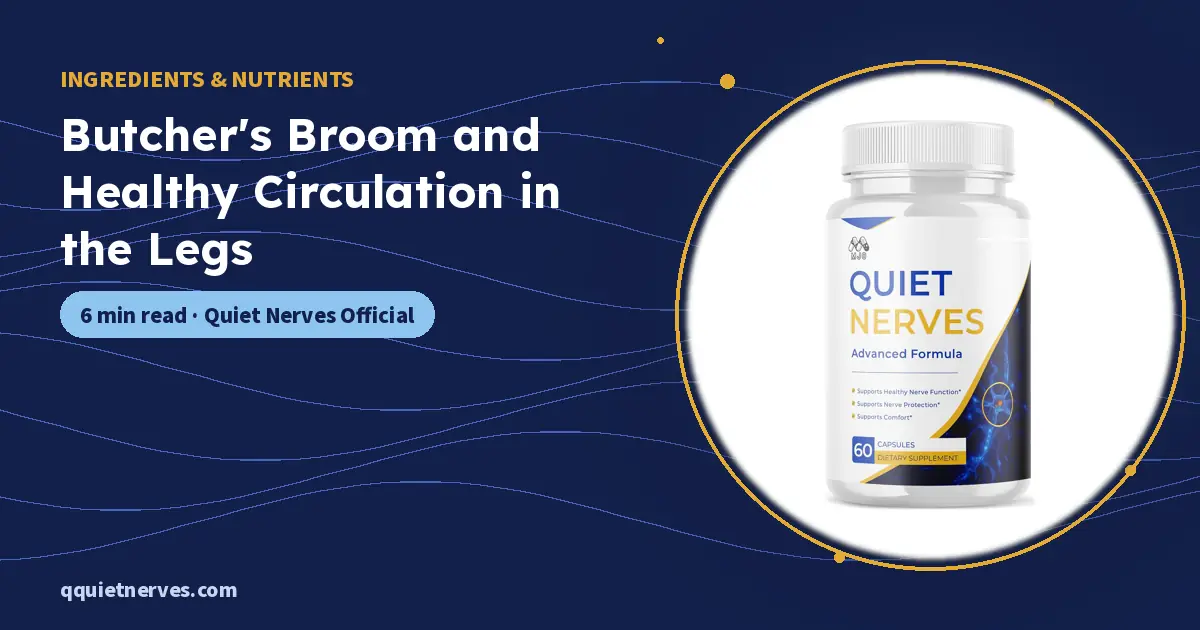
Butcher's broom (Ruscus aculeatus) is an evergreen shrub whose root contains compounds called ruscogenins. It has been studied for supporting healthy vein tone and circulation in the legs, especially for heaviness and swelling. Quiet Nerves includes it for circulation support. People on blood thinners or blood-pressure medicines should ask a doctor first.
Key takeaways
- Butcher's broom has a long history of use for tired, heavy legs.
- Research mostly looks at vein tone and leg circulation, often combined with other ingredients.
- Blood thinners, blood-pressure medicines, pregnancy and planned surgery mean a doctor check first.
- In Quiet Nerves it supports circulation, which helps deliver nutrients to nerves.
A strange name with a practical history
The story goes that European butchers once bundled the stiff, spiky branches of this shrub to scrub their chopping blocks. The name stuck. Long before that, herbalists around the Mediterranean were using its root for a very different job: easing the heavy, achy feeling in the legs at the end of a long day.
Today the plant goes by its botanical name, Ruscus aculeatus, and it shows up in circulation formulas, including Quiet Nerves.
Why circulation matters to your nerves
Nerves in your feet and lower legs sit at the far end of your circulation. Like every tissue, they rely on a steady supply of blood for oxygen and nutrients. When circulation is sluggish, many people notice cold feet, swelling around the ankles or legs that feel like lead by evening.
Poor circulation is one of several factors doctors look at when someone reports leg or foot discomfort. The NINDS peripheral neuropathy overview describes the many possible causes of nerve symptoms, which is why a diagnosis always comes first.
Daily habits make a real difference here. Sitting for hours with your legs crossed, standing still in one spot all day and skipping walks can all leave your lower legs feeling sluggish. Simple changes, such as short walking breaks every hour, ankle circles while you watch television and keeping well hydrated, give your circulation a helping hand alongside any supplement.
For practical habits that help, read 10 everyday ways to support circulation in your legs.
What researchers have studied
The active compounds in butcher's broom root are called ruscogenins. They appear to help veins keep their tone, so blood returns toward the heart rather than pooling in the lower legs.
- Most studies involve people with mild venous issues who report heaviness, swelling or cramps.
- Many trials tested butcher's broom alongside hesperidin and vitamin C, so it is hard to credit the plant alone.
- Results generally point to improved comfort and reduced swelling, but study sizes vary.
You can explore the published research through this PubMed search on Ruscus aculeatus and venous circulation. The fair summary: butcher's broom is studied for leg circulation support, with reasonable but not definitive evidence.
Safety: who should be careful
| Situation | Why it matters |
|---|---|
| Blood thinners or antiplatelets | Anything affecting circulation deserves a doctor's review alongside these medicines. |
| High blood pressure or BP medicines | Butcher's broom acts on blood vessel tone, so your doctor should weigh in. |
| Pregnancy or breastfeeding | Safety has not been established. |
| Surgery planned | Tell your surgeon about all supplements well beforehand. |
Some people notice mild nausea or stomach upset. Sudden swelling in one leg, especially with pain, warmth or redness, needs prompt medical attention rather than a supplement. See our side-effects page and the homepage safety notes for more.
Quick tip: Raise your legs on a cushion for fifteen minutes each evening. It is free, pairs well with any supplement routine and many people find it soothing.
How butcher's broom works within Quiet Nerves
In Quiet Nerves, butcher's broom handles the circulation side of the formula. It sits beside magnesium glycinate and alpha lipoic acid for nerve support, L-carnitine and CoQ10 for cellular energy, and turmeric extract for everyday comfort. The thinking is simple: well-supported nerves need a healthy blood supply, and good circulation helps nutrients reach them.
Quiet Nerves supports healthy circulation and nerve comfort. It does not treat vein disease or nerve conditions. To see all six ingredients side by side, visit Quiet Nerves ingredients explained.
Start supporting your legs today
Circulation support is a long game. Plan on several weeks of daily use; the brand reports that many users notice changes in two to four weeks and some report clearer differences at six to ten. Results vary.
The 6-bottle package is the Best Value at $49 per bottle for a 180-day supply, while the 3-bottle option gives 90 days at $69 per bottle. Shipping is free and every order has a 60-day money-back guarantee. Pick your Quiet Nerves supply today, since bundle prices and bonuses can change. Unsure which size? The price comparison and the complete guide walk you through it, or simply order from the official site.
Also worth reading: Can You Take Quiet Nerves With Your Medications? and Magnesium Glycinate: Why This Form Is Gentle and Well Absorbed and How Long Do Nerve Supplements Take to Work?.
Frequently asked questions
Is butcher's broom safe for older adults?
Many older adults use it without trouble, but those on blood thinners, blood-pressure medicines or several prescriptions should ask a doctor or pharmacist first. Mild stomach upset is the most commonly reported effect.
Will butcher's broom help numb feet?
Numb feet need a doctor's evaluation to find the cause. Butcher's broom is studied for leg circulation and heaviness. In Quiet Nerves it supports healthy circulation, not the diagnosis or treatment of numbness.
Can I get butcher's broom from food?
Not really. Young shoots have been eaten in some regions, but the compounds studied for circulation come from the root and are used as concentrated extracts in supplements like Quiet Nerves.
Health note: have numbness, tingling, burning or weakness checked by a doctor, and ask before combining Quiet Nerves with blood thinners, diabetes, blood-pressure or thyroid medicines. Call 911 for sudden one-sided weakness or trouble speaking. Educational content only – see our disclaimer.